
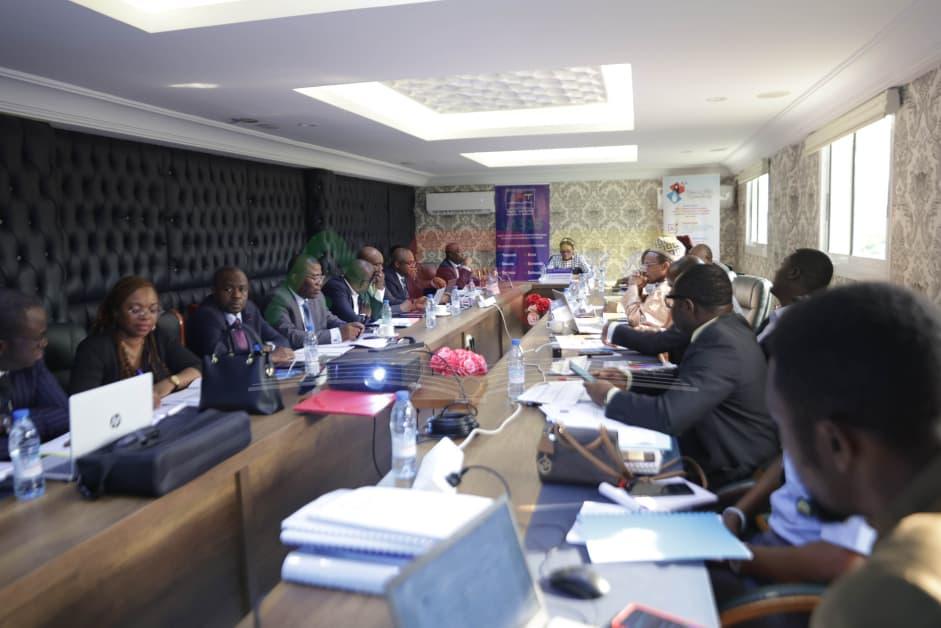
On Thursday, 26 November 2026, at the United Hotel in Mbankomo, the Chairperson of the Board of Directors of the Telecommunications Regulatory Board (TRB), Professor Justine DIFFO née TCHUNKAM, chaired a working session dedicated to reviewing the Board’s 2026–2030 Strategic Performance Plan.
The meeting brought together members of the Board of Directors, the Executive Management led by Director General Professor Philémon ZOO ZAME, assisted by Deputy Director General ZOURMBA ABOUBAKAR, as well as several senior officials of the Agency and a number of special guests.
The session formed part of ongoing efforts to modernize public sector governance and strengthen the TRB’s strategic role in advancing Cameroon’s digital economy. Presented for review and discussion, the 2026–2030 Strategic Performance Plan will serve as the Agency’s roadmap for the next five years, at a time when the electronic communications sector is undergoing profound transformation.
Prepared in line with the public institutions alignment framework issued by the Ministry of Economy, Planning and Regional Development (MINEPAT), the document succeeds the 2022–2025 Strategic Development Plan. It translates government policy orientations into measurable objectives for the regulator and is aligned with key national frameworks, particularly Cameroon’s National Development Strategy 2020–2030 (NDS30), as well as sectoral programmes implemented by supervisory ministries.
During the proceedings, Board members reviewed the Plan’s core components, including the state of the sector, the proposed strategic priorities, the performance framework, financing arrangements, and the implementation, monitoring and evaluation mechanisms.
The analyses presented highlighted a sector experiencing robust growth and rapid change. Between 2021 and 2025, the number of active mobile subscriptions nearly doubled, rising from 20.7 million to 39.9 million. Over the same period, data traffic increased fourfold, while sector revenues surpassed CFAF 1 trillion. The sector’s contribution to gross domestic product also rose to 3.16%. This sustained expansion underscores the need for a regulatory approach that places greater emphasis on service quality, technological innovation, consumer protection and the sustainable development of digital infrastructure.
The 2026–2030 SPP sets out an ambitious objective: to position the TRB as an agile, credible and innovative regulator, fostering a modern, secure, inclusive, competitive and sustainable electronic communications ecosystem that supports both digital sovereignty and Cameroon’s socio-economic development.
This vision is underpinned by a renewed commitment to proactive, fair and transparent regulation, guided by the core values of transparency, integrity, innovation, professionalism, accountability and inclusion.
To achieve these goals, the Plan is structured around four major strategic pillars: connectivity and the enabling environment, digital transformation, recovery of sector financial resources, and governance and support functions.
Participants underscored the relevance of the five priority programmes identified for the five-year period. These include strengthening coherence between regulatory action and sector public policies, anticipating challenges associated with emerging technologies such as 5G, artificial intelligence and satellite-based systems, improving service quality for users, enhancing oversight of the national fibre-optic backbone network, and reinforcing digital trust.
Beyond its programmatic dimension, the 2026–2030 SPP reflects a profound shift in the TRB’s management culture. It marks a transition from an activity-based approach to one centred on measurable results and tangible impact.
The performance framework sets ambitious targets for digital coverage, quality-of-service supervision, 5G deployment, sector revenue mobilization and institutional performance. Among the headline objectives are extending continuous service-quality monitoring to 25 cities, achieving 85% nationwide broadband coverage by 2030, and maintaining a collection rate exceeding 100% of planned sector resources.
The Plan also includes a series of strategic investments aimed at strengthening the Agency’s technical and operational capabilities. These initiatives cover the modernization of the type-approval laboratory, 5G spectrum monitoring, fraud prevention, the digitization of internal processes, and the deployment of next-generation technological infrastructure.
With a total budget envelope of CFAF 420.6 billion over the 2026–2030 period, the Strategic Performance Plan is intended to serve as the TRB’s principal reference framework for action over the next five years.
At the conclusion of the discussions, participants commended both the quality of the work carried out and the coherence of the document in addressing the current and future challenges facing the electronic communications sector. They also welcomed its performance-driven approach, built on transparency, innovation and accountability, which is expected to further strengthen the TRB’s contribution to Cameroon’s digital transformation.
The Mbankomo meeting therefore marks an important milestone in the ongoing consolidation of the Agency’s strategic governance framework. Through the 2026–2030 Strategic Performance Plan, the TRB is equipping itself with a modern and ambitious framework to address emerging technological challenges, sustainably improve the quality of services delivered to users, and make a stronger contribution to Cameroon’s digital sovereignty and socio-economic development.
Looking ahead to 2030, the Plan seeks to establish the TRB as a more agile, efficient and forward-looking regulator, fully responsive to the expectations of citizens, operators and public authorities.
Eric-Serge Maye Angouan’d
Source : ART Cameroun
0 commentaires